
Researchers at Massachusetts Institute of Technology (MIT) have discovered a new way of storing energy from sunlight that could lead to ‘unlimited’ solar power.
The process, loosely based on plant photosynthesis, uses solar energy to split water into hydrogen and oxygen gases. When needed, the gases can then be re-combined in a fuel cell, creating carbon-free electricity whether the sun is shining or not.
According to project leader Prof. Daniel Nocera, “This is the nirvana of what we’ve been talking about for years. Solar power has always been a limited, far-off solution. Now, we can seriously think about solar power as unlimited and soon.”
Read more here.
Monday, January 26, 2009

Sunday, January 25, 2009
Scientists Find New Way to Produce Hydrogen
“The ability to produce hydrogen at room temperature is significant because it means that we did not use any heat or energy to trigger the reaction,” said Khanna. “Traditional techniques for splitting water to produce hydrogen generally require a lot of energy at the time the hydrogen is generated. But our method allows us to produce hydrogen without supplying heat, connecting to a battery, or adding electricity. Once the aluminum clusters are synthesized, they can generate hydrogen on demand without the need to store it.” Read more here.
Thursday, January 22, 2009
World Carbon Dioxide Emissions Since the year 1750
## |
World CO2 since 1750 (cubic feet) |
Since 1750, humans have emitted over 5 trillion pounds of carbon dioxide into the atmosphere. Roughly half of this has ended up in the oceans where it is beginning to damage the coral reefs. The other half is still in the atmosphere and causing global warming.
Now, imagine if that carbon dioxide was separated back into carbon and oxygen- imagine if the carbon was turned back into a solid form and deposited back onto the surface of the earth- a black hail covering the surface of the earth with a ubiquitous layer of carbon dust.
Tuesday, January 13, 2009
News story:UFOs in UK, US called ‘octopus, jellyfish, amoeba, cocoon, biological’
Dont worry. This isnt us link
Friday, January 9, 2009
Friday, January 2, 2009
When Scientists Realized they needed a carbon extraction geo-engineering solution to the problem of Climate Change
This post intercepted from Steve Connor, Independent UK. January 2, 2009.
----
Levels of CO2 have continued to increase during the past decade since the Kyoto treaty was agreed and they are now rising faster than even the worst-case scenarios from the Intergovernmental Panel on Climate Change, a United Nations body. In the meantime the natural absorption of CO2 by the world's forests and oceans has decreased significantly. Most of the scientists we polled agreed that the failure to curb emissions of CO2, which are increasing at a rate of 1 per cent a year, has created the need for an emergency "plan B" involving research, development and possible implementation of a worldwide geoengineering strategy.
Just over half -- 54 per cent -- of the 80 international specialists in climate science who took part in our survey agreed that the situation is now so dire that we need a backup plan that involves the artificial manipulation of the global climate to counter the effects of man-made emissions of greenhouse gases. About 35 per cent of respondents disagreed with the need for a "plan B", arguing that it would distract from the main objective of cutting CO2 emissions, with the remaining 11 per cent saying that they did not know whether a geoengineering strategy is needed or not.
---Tuesday, December 30, 2008
What are the Jellyfish?
This communication was intercepted Saturday, September 27, 2008 12:46 AM
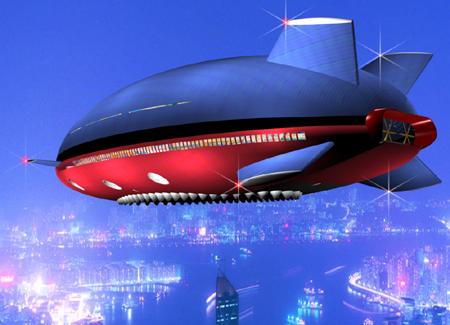
They are these large Zepplin-like heavy-lifting semi-Buckyball lighter-than-air, stronger-than-steel, honey-combed aero-gel superstructure, cargo-blimps.
They are white like the clouds and shaped like half a marshmallow, smooth spherically curved top, like the cap of a tooth, holding within it the lighter than air, non-flammable, buoyancy gas sacks. This cargo-blimp lifting structure sits like an open umbrella on the long cylindrical carbon sieves that hang beneath this autonomous buoy. They are covered with solar cells that power the carbon sieves.
Every so often, the blimps "poop" out a carbon brick- or pelt the landscape with a black hail of carbon pelts. Huge packs of them float through our atmosphere like jelly fish in the deep ocean. But these are bio-engineered with nano-technology to "harvest" carbon dioxide gas from the atmosphere at the highest efficiency possible. They are attracted in packs to locations of intense carbon emissions, their food; they hover above cities and forest fires, volcanoes and cattle feed lots, factory smoke stacks and oil refineries. They vary from the size of a Hot Air Balloon to the size of a Football Stadium.....
They are actually free-floating autonomous self-replicating carbon extractors that look something like a cross between the giant sub-orbital Long Duration Balloon (here), but made out a more rigid superstructure from carbon aero-gels (here) and (here). So the thing would have a smokey bluish translucence, (like jellyfish), but would also have a patterned sequined exterior surface from the mini photo-voltaic solar cell panels used to power the craft.
The thing is essentially a sophisticated robot, mimicked after real-world organic adaptations, but designed to extract carbon from the atmosphere. The quantity of them in the sky is comparable to the quantity of combustion engines on earth. When storms approach they automatically inflate and rise above bad weather, then descend and continue their carbon extraction activities from the atmosphere.
This idea came to me after view an image of the earth infected with a carbon producing virus:
http://www.youtube.com/watch?v=1XBwjQsOEeg
They are these large Zepplin-like heavy-lifting semi-Buckyball lighter-than-air, stronger-than-steel, honey-combed aero-gel superstructure, cargo-blimps.
They are white like the clouds and shaped like half a marshmallow, smooth spherically curved top, like the cap of a tooth, holding within it the lighter than air, non-flammable, buoyancy gas sacks. This cargo-blimp lifting structure sits like an open umbrella on the long cylindrical carbon sieves that hang beneath this autonomous buoy. They are covered with solar cells that power the carbon sieves.
Every so often, the blimps "poop" out a carbon brick- or pelt the landscape with a black hail of carbon pelts. Huge packs of them float through our atmosphere like jelly fish in the deep ocean. But these are bio-engineered with nano-technology to "harvest" carbon dioxide gas from the atmosphere at the highest efficiency possible. They are attracted in packs to locations of intense carbon emissions, their food; they hover above cities and forest fires, volcanoes and cattle feed lots, factory smoke stacks and oil refineries. They vary from the size of a Hot Air Balloon to the size of a Football Stadium.....
They are actually free-floating autonomous self-replicating carbon extractors that look something like a cross between the giant sub-orbital Long Duration Balloon (here), but made out a more rigid superstructure from carbon aero-gels (here) and (here). So the thing would have a smokey bluish translucence, (like jellyfish), but would also have a patterned sequined exterior surface from the mini photo-voltaic solar cell panels used to power the craft.
The thing is essentially a sophisticated robot, mimicked after real-world organic adaptations, but designed to extract carbon from the atmosphere. The quantity of them in the sky is comparable to the quantity of combustion engines on earth. When storms approach they automatically inflate and rise above bad weather, then descend and continue their carbon extraction activities from the atmosphere.
This idea came to me after view an image of the earth infected with a carbon producing virus:
http://www.youtube.com/watch?v=1XBwjQsOEeg
Thursday, December 25, 2008
Progress Dec.25
Jellyfishes purposes

main purpose: air cleaner/purifier- inhale Carbon and exhale oxygen
secondary purpose:
GPS network
cell phone tower
homeland security
-tracking
-security cameras
Power (nutrition)
-photo voltaic cells covering the membrane (skin)
alternate (back up power)
-wind turbines
-hydroelectric (water from ocean)
Brains:
? gears, clockwork parts
based on/ and giving props to ancient technology
a mix of ancient and futuristic technology
- based on the Antikythera mechanism-
it was a hand-wound clockwork device used by the ancient Greeks to calculate the motions of the sun, moon and planets as seen from Earth, as well as to predict solar and lunar eclipses.
-self automated
-self replicating system
-rapid prototype ( each part is grown)
-at regular intervals newer, larger parts are created for all systems from the core outward
Lifecycle:
?spores
?or eggs are created (hatched in a nest)
-like fish eggs they stay attached to the adult
larve stage
-they feed off of the adult.
-the grow in proportion to the adult diminishing.
-the adult then becomes waste product
-the adult is broken down into carbon blocks that fall away
-the carbon blocks are dense, light weight, biodegradable, small bricks
Thursday, December 18, 2008
Wednesday, December 17, 2008
progress Dec. 17 2008 (thoughts)
self-replicating factories
lifecycle:
egg
pupa
larvae
adult
tunnels or tubes with a rail in the center that transports. Acts as a blood vessel. Sending raw materials in and waste materials (C02) out.
power supply: wind turbines? solar panels. solar voltaic cells.
The project released its designs and control programs under the GNU GPL. Using the help of citizens home computers to calculate the data.
lifecycle:
egg
pupa
larvae
adult
tunnels or tubes with a rail in the center that transports. Acts as a blood vessel. Sending raw materials in and waste materials (C02) out.
power supply: wind turbines? solar panels. solar voltaic cells.
The project released its designs and control programs under the GNU GPL. Using the help of citizens home computers to calculate the data.
progress Dec. 17 2008 (references)
Thinking and researching
looking into aerogel. Found this website dealing with using people as free labor for science
http://stardustathome.ssl.berkeley.edu/
lifecycle:
egg
larva
pupa
adult
sources:
Extraction Of Carbon Dioxide From Atmosphere Seen Possible
http://www.futurepundit.com/archives/004648.html
Nanotech replicators to build solar photovoltaics panels
http://www.futurepundit.com/archives/003996.html
talks about self replicating machines possibility
self replicating machines:
A fundamental obstacle of self-replicating machines, how to repair the repair systems, was the critical failure in the automated society described in The Machine Stops.
Cellular automaton:
Stoma (medicine), an opening which connects a portion of the body cavity to the outside environment
http://www.reprap.org/bin/view/Main/WebHome
looking into aerogel. Found this website dealing with using people as free labor for science
http://stardustathome.ssl.berkeley.edu/
lifecycle:
egg
larva
pupa
adult
sources:
Extraction Of Carbon Dioxide From Atmosphere Seen Possible
http://www.futurepundit.com/archives/004648.html
Nanotech replicators to build solar photovoltaics panels
http://www.futurepundit.com/archives/003996.html
talks about self replicating machines possibility
self replicating machines:
A fundamental obstacle of self-replicating machines, how to repair the repair systems, was the critical failure in the automated society described in The Machine Stops.
Von Neumann
Berserkers The name is derived from a series of novels by Fred Saberhagen feature an ongoing war between humanity and such machinesCellular automaton:
Some living things use naturally occurring cellular automata in their functioning.
Patterns of some seashells, like the ones in Conus and Cymbiola genus, are generated by natural CA. The pigment cells reside in a narrow band along the shell's lip. Each cell secretes pigments according to the activating and inhibiting activity of its neighbour pigment cells, obeying a natural version of a mathematical rule.[citation needed] The cell band leaves the colored pattern on the shell as it grows slowly. For example, the widespread species Conus textile bears a pattern resembling the Rule 30 CA described above.
Conus textile photo link: http://en.wikipedia.org/wiki/Image:Textile_cone.JPG#file
Stoma (medicine), an opening which connects a portion of the body cavity to the outside environment
Moore's artificial living plants
In 1956 mathematician Edward F. Moore proposed the first known suggestion for a practical real-world self-replicating machine, also published in Scientific American.[15][16] Moore's "artificial living plants" were proposed as machines able to use air, water and soil as sources of raw materials and to draw its energy from sunlight via a solar battery or a steam engine. He chose the seashore as an initial habitat for such machines, giving them easy access to the chemicals in seawater, and suggested that later generations of the machine could be designed to float freely on the ocean's surface as self-replicating factory barges or to be placed in barren desert terrain that was otherwise useless for industrial purposes. The self-replicators would be "harvested" for their component parts, to be used by humanity in other non-replicating machines.
Nanoscale Silica May Be Key To Hydrogen Storage
http://www.futurepundit.com/archives/cat_nanotech_for_energy_tech.html
nanophotonics
Fused Deposition Modelling FDM http://en.wikipedia.org/wiki/Fused_deposition_modeling
RepRap is short for Replicating Rapid-prototyper.http://www.reprap.org/bin/view/Main/WebHome
Subscribe to:
Posts (Atom)


